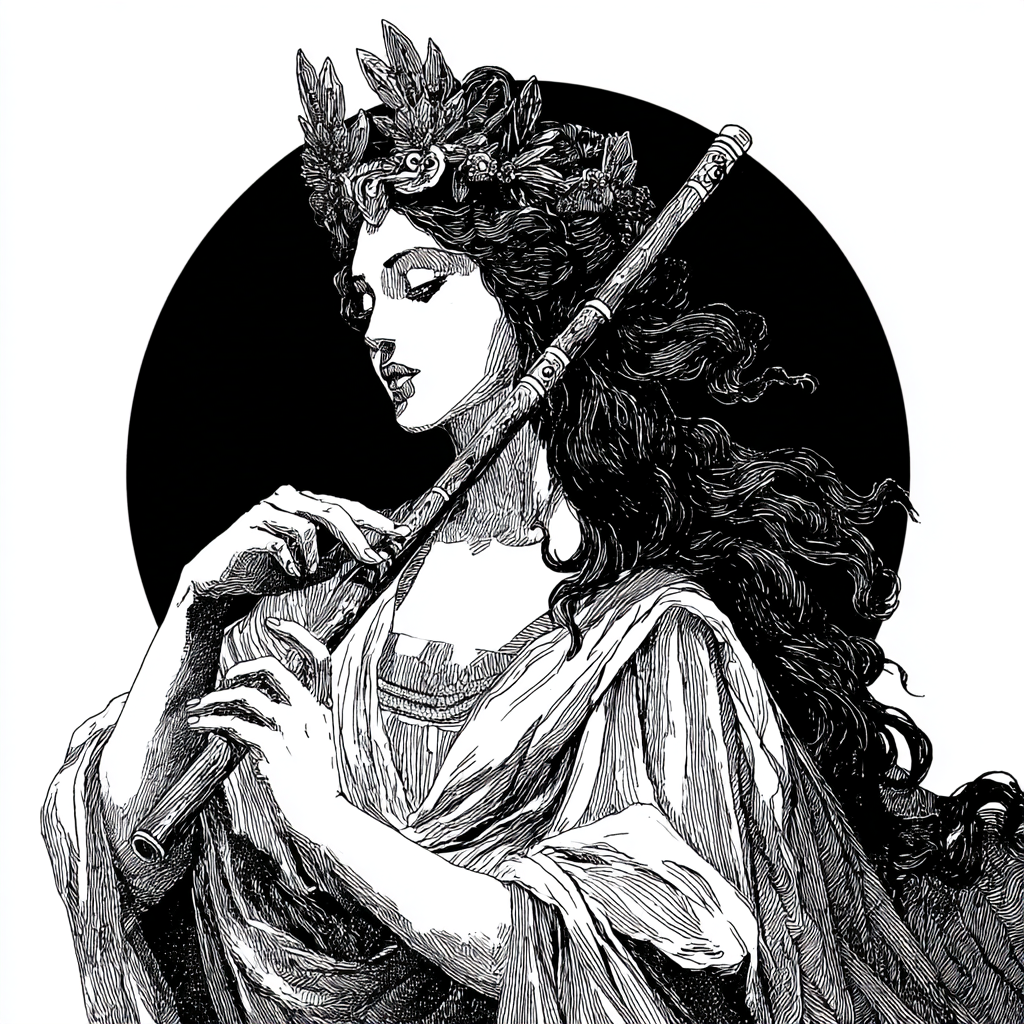
Named after Calliope (Καλλιόπη, "fair-voiced") — chief of the nine Muses, daughter of Mnemosyne and Zeus, presiding Muse of epic poetry. The Muse Homer invokes at the opening of the Iliad: "Sing, goddess, the wrath of Achilles." Where her mother mnemo preserves what is known, Calliope invents — the only tool in this family that makes something new rather than retrieving, verifying, or organising what's already there. Mother and daughter, memory and narrative: the only mythic pairing in the set.
How it works
Calliope clones a fiction voice across 10 dimensions (or picks a genre preset), generates a three-act outline with per-scene goal / conflict / emotional beat / story-value shift, drafts scene by scene under a six-layer context stack whose sixth layer — canon — is rebuilt after every chapter so future chapters know who's where, who knows what, who's injured, what's been promised. Every draft is mechanically scanned for fiction-specific AI tells; a 7-pass revision pipeline finishes with an Anthropic Opus polish. Exports to KDP-ready PDF / DOCX / ePub.
A word about how to use this
Calliope is a drafting and revision partner, not a ghostwriter. It does the mechanical parts of writing a long book — voice consistency across 80,000 words, continuity across twenty chapters, scene-level structure, multi-pass revision, print-ready formatting — so a human author can spend their time on the things only they can do: the what and the why of the story, and the final sentence-by-sentence judgment of whether it reads true.
Every chapter it produces is a starting point. You read every scene. You rewrite the dialogue until each character actually sounds like themselves. You own every sentence in the finished manuscript. The slop scanner and the polish pass are mechanical aids — they catch the AI-shaped patterns a human editor would also catch, but they don't substitute for your editorial judgment and they don't put your name on the cover. Treat Calliope the way you'd treat a very capable co-writer whose drafts you still have to rewrite: helpful, fast, and absolutely not the signatory on the title page.
MCP tools
analyze_voice(sample)— extract a 10-dimension fiction voice fingerprint from 3K+ words.plan_story(premise, genre, length, voice, pov, tone)— three-act outline with characters, world, and per-scene goals / conflicts / beats / story-value shifts.write_chapter(chapter_number, ...)— draft a single chapter scene-by-scene under the 6-layer context stack. Canon is auto-updated afterward.revise(target, revision_focus?)— run the 7-pass pipeline on a chapter or the full manuscript; or pass a single pass name to run just that one.get_manuscript()— retrieve the assembled manuscript and per-chapter progress.export_story(formats)— export to markdown / PDF (KDP trim sizes) / DOCX / ePub.
Genre presets
Each preset maps to a voice profile and a set of style references:
| Genre | Style references |
|---|---|
| literary | Cormac McCarthy · Donna Tartt |
| thriller | Lee Child · Gillian Flynn |
| fantasy | Patrick Rothfuss · Ursula K. Le Guin |
| romance | Emily Henry · Talia Hibbert |
| mystery | Tana French · Ruth Ware |
| scifi | Ted Chiang · Becky Chambers |
| horror | Shirley Jackson · Paul Tremblay |
Presets get the agent productive the minute an author opens it. analyze_voice on 3K+ words of the author's own prose takes over when they want their own voice instead.
The 6-layer context stack
Each write_chapter call assembles all six layers before drafting so chapter N stays coherent with chapters 1..N-1:
- Premise — the core story. Never changes.
- World — setting, rules, physical detail from the world bible.
- Characters — motivations, arcs, and the speech patterns that make each one sound distinct.
- Outline — windowed: previous chapter, current chapter (full scene detail), next chapter.
- Voice — the cloned profile or a genre preset.
- Canon — running continuity: locations, knowledge states, emotional state, injuries, relationships, open and closed plot threads, timeline movement, world-state changes. Rebuilt by Claude Sonnet after every chapter, auto-compressed every 4 chapters once it crosses ~8K tokens.
The 7-pass revision pipeline
| # | Pass | Backend | What it does |
|---|---|---|---|
| 1 | plot_structure | OpenRouter | Every scene has conflict, story value shifts, chapter advances the plot. |
| 2 | character_voice | OpenRouter | Dialogue distinctness, motivation consistency, arc progression. |
| 3 | show_dont_tell | OpenRouter | Convert narrator-told emotions to action / dialogue / sensory detail. |
| 4 | pacing | OpenRouter | Chapter hooks, paragraph length variation, tension control. |
| 5 | line | OpenRouter | Verb strength, adverb cuts, sentence rhythm, cliché removal. |
| 6 | slop | regex (free) | Fiction AI-tell scanner · body / breath / emotion / time / hedge. |
| 7 | polish | Anthropic Opus | Final quality judgment with a numeric score and an issues list. |
Notable design notes
- Mother and daughter. Calliope is the only one of these MCPs that invents rather than preserves, verifies, observes, or organises. Mnemosyne stores what's known; her daughter Calliope spins new stories from it. They're the only pair in the family whose myth maps onto the tool relationship.
- Scenes, not chapters, are the unit of craft. Every scene gets its own goal / conflict / emotional beat / story-value shift at plan time, and the drafter is required to hit all four. Single-shot AI fiction fails most often at the scene level — sequences of paragraphs with no conflict and no shift. Planning at the scene level and drafting scene-by-scene is the specific answer to that failure mode.
- Canon is a sixth layer, not a patched-in afterthought. Running canon is auto-extracted by Claude Sonnet after every chapter and fed back as a first-class layer on the next draft. That's how a 75,000-word manuscript stays coherent without the author re-briefing every chapter.
- Stricter slop threshold than non-fiction. 8 hits per 1K words instead of Daedalus's 10. Fiction earns its words harder.
- Multi-model cost split. OpenRouter for the high-volume work (drafting, 5 of 7 revision passes), Claude Sonnet for targeted analytical work (voice analysis, canon extraction), Anthropic Opus only for the single place quality matters most (the polish pass). Keeps a novel affordable.
Stack
- FastMCP (Python)
- Anthropic Opus (polish)
- Claude Sonnet (voice + canon)
- OpenRouter (drafting + revision)
- pandoc + tectonic (PDF / DOCX / ePub)
- book-class LaTeX (KDP trim sizes)
- Docker Compose
- LibreChat (host)
Sister to daedalus the craftsman: same long-form rigor, different discipline. Daedalus builds non-fiction by patient assembly; Calliope invents narrative through scene-level conflict. The Muse and the master craftsman.